





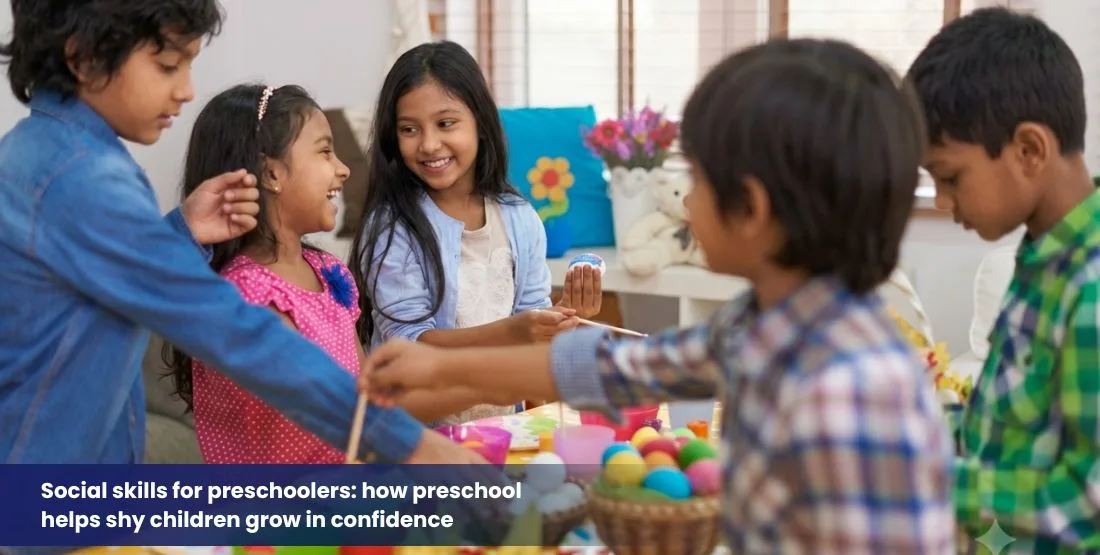
On the first morning, she hides behind her mother’s dupatta and watches the classroom with wide eyes. Many parents know this moment well. Social skills for preschoolers grow slowly and in their own time, and a caring preschool can help even the quietest child find their voice without ever being pushed.
Is it normal for a preschooler to be shy?
Yes. Shyness is part of a child’s natural temperament. Some children jump straight into a new group, while others prefer to watch first and join in later. A quiet child is often thoughtful and observant, which is a real strength.
What shy children need is time, patience and a safe space to try. They do not need to be labelled or rushed. In our experience, the child who stands at the edge of the room in June is often the one leading a group game by December.
If the first goodbye is the hardest part, our guide on separation anxiety in toddlers shares simple ways to prepare at home.
How do teachers help shy children feel comfortable?
Good teachers never force a shy child to speak or perform. They give the child time to observe, offer gentle invitations to join in and celebrate every small step. A warm greeting, a familiar routine, and a kind friend nearby help a quiet child feel safe enough to open up.
Here is how teachers support quiet children through the day:
What teachers do | How it helps |
Greet each child warmly by name | The child feels seen and welcome |
Let the child watch before joining | Removes pressure and builds trust |
Pair the child with a friendly buddy | Makes it easier to join play |
Give small jobs, like handing out crayons | Builds a sense of belonging and pride |
Praise effort, not just results | Encourages the child to try again |
Keep routines predictable | Helps the child know what comes next |
Did you know? According to the Harvard Center on the Developing Child, back-and-forth “serve and return” interactions between children and caring adults help build the brain connections needed for communication and social skills.
How does group play build social skills for preschoolers?
Group play gives children many small chances to practise being social, from greeting a friend to waiting for a turn. Each small success, like sharing a toy or joining a game, makes the next step a little easier for a quiet child.
Well-planned group activities for kindergarten and pre-primary school, such as building together, singing in a circle or playing simple team games, help children learn the unwritten rules of friendship. A shy child might first join by passing the ball. A few weeks later, the same child may suggest the next game.
Strong social skills for preschoolers shape a child’s overall development. Children who can ask for help, share ideas and work with others settle more easily into big school and handle new situations with confidence.
How can parents help a shy child at home?
What can parents do to help a shy child at home?
Small, steady steps at home help shy children grow without feeling pressured:
- First, plan playdates with a single friend before attempting to organise them with larger groups.
- Use role play with toys to practice saying greetings and asking other people to join in a game.
- Don’t call your child shy in the presence of other people since children tend to conform to such labels.
- Make a point of noticing and praising bold moments, for example, when you say hello to a neighbour.
Stories are another gentle way to build confidence. Retelling a favourite tale or acting out a character helps quiet children practise speaking, as we explain in our post on storytelling for preschoolers.
If your child does not speak at school at all for several weeks, or if fear stops them from everyday activities, speak to your paediatrician or a child specialist for guidance.
How does Alphakids support quiet children?
At Alphakids International, every day begins with Alpha Greet, our morning greeting routine, so each child feels welcomed by name. During Alpha Circle, our circle time, children sing, share and listen in a small, familiar group where even a whisper is welcome.
Our teachers are trained in early childhood education and our ASTERIA pedagogy, which builds EQ alongside IQ. They focus on warm interactions, personal attention and observation-based assessment, so they notice when a quiet child is ready for the next small step. Parents receive updates through our parent app and are treated as partners in their child’s growth.
Celebrations, theme days, Grandparents’ Day and our Annual Concert give children gentle chances to shine. As one parent shared, “Sid has become more independent and confident, showing great leadership among his friends.”
Help your child find their voice.
Every child blossoms at their own pace. If you are looking for the best preschool in Vadodara, where quiet children are understood and encouraged, we would love to meet you. Book a campus visit to our Karelibaug campus or call +91 92279 91016 to meet our teachers.
FAQs
Yes. Shyness is a normal part of many children’s temperament. Some children like to watch before joining in. With patience, warm routines and gentle encouragement, most shy children grow more comfortable over time.
Teachers allow them to observe without forcing them to speak, pair them up with a friendly partner and praise any small brave actions. For shy children, predictable routines and warm greetings help them to feel safe and thus join in.
Plan playdates with a single friend, practice greetings by doing role play, don’t call your child shy in the presence of others, and praise each instance of bravery. Taking small and steady steps will help build lasting confidence.
Speak to your paediatrician or a child specialist if your child does not speak at school at all for several weeks, or if fear stops them from enjoying everyday activities.
Teachers greet each child by name every morning, use small circle time groups and give personal attention. They notice when a quiet child is ready for the next step and keep parents updated.